


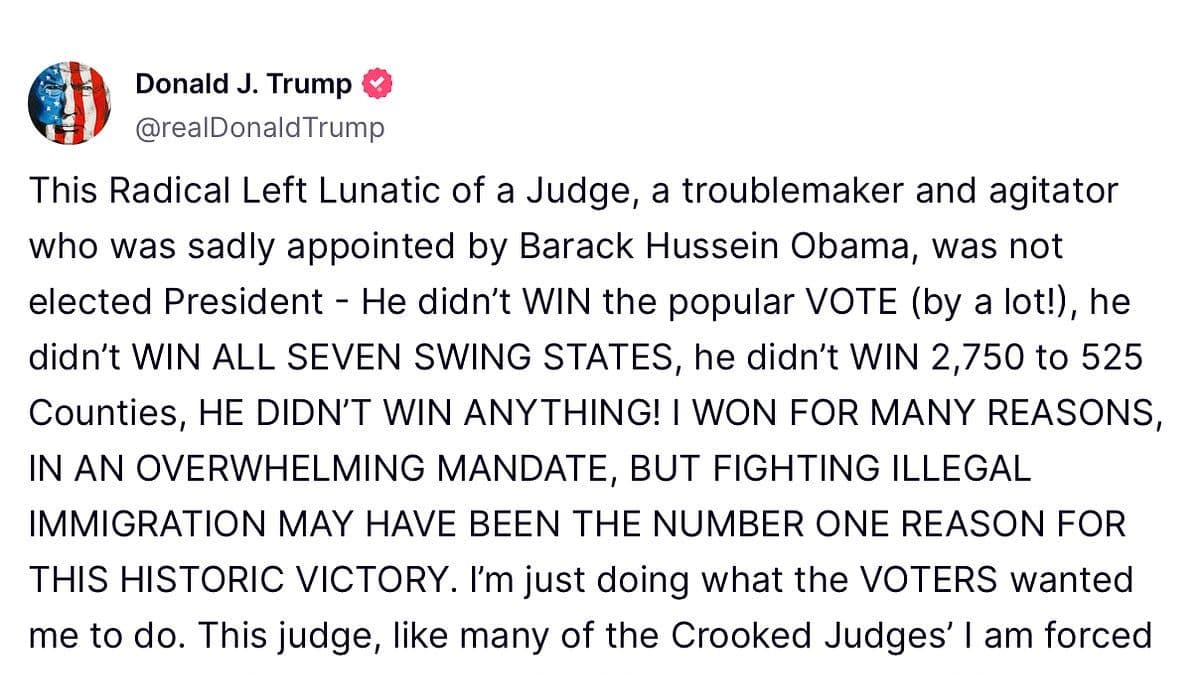
In an unprecedented move, Donald Trump has called for the impeachment of U.S. District Judge James Boasberg. This demand follows Judge Boasberg's issuance of a temporary restraining order halting the administration's deportation of Venezuelan migrants, a decision that has intensified debates over executive authority and judicial independence.
If you appreciate independent, no-nonsense reporting that cuts through the spin, consider becoming a paid subscriber. Your support helps me continue holding this Administration accountable in pursuit of the truth.
Subscribe
Background of the Dispute
The controversy centers on the Trump administration's recent deportation of Venezuelan migrants to El Salvador, justified under the 1798 Alien Enemies Act. The administration alleges that these individuals are members of the Tren de Aragua gang, posing a national security threat. However, Judge Boasberg challenged this rationale, expressing concerns over potential constitutional conflicts arising from the executive's actions. As a result, Judge Boasberg halted the deportations for a period of 14 days. The Trump Administration completely and intentionally disregarded his ruling and deported individuals anyways.
The Impeachment Process for Federal Judges
Impeaching a federal judge is a rigorous process outlined in the U.S. Constitution. It begins in the House of Representatives, where any member can initiate proceedings by presenting charges or requesting a referral to the appropriate committee. The House Judiciary Committee typically investigates the allegations to determine if there are grounds for impeachment.
If the committee finds sufficient cause, it drafts articles of impeachment, which are then debated and voted upon by the full House. A simple majority vote is required to impeach. Following impeachment, the process moves to the Senate, which conducts a trial presided over by the Chief Justice if the president is being tried, or by the Vice President or President pro tempore in other cases. Conviction and removal from office require a two-thirds majority vote in the Senate. Historically, impeachment of federal judges has been rare, with only 15 impeachments and eight convictions since the nation's founding.
Trump's call for Judge Boasberg's impeachment raises significant concerns regarding the separation of powers and the independence of the judiciary. Impeachment is intended as a mechanism to address serious misconduct, not as a response to judicial decisions unfavorable to the executive branch. Utilizing impeachment in this manner could set a precarious precedent, where judges might feel pressured to rule in favor of the prevailing political powers to avoid retribution, thereby undermining judicial impartiality.
The Parnas Perspective is a reader-supported publication. To receive new posts and support my work, consider becoming a paid subscriber.
Subscribe