


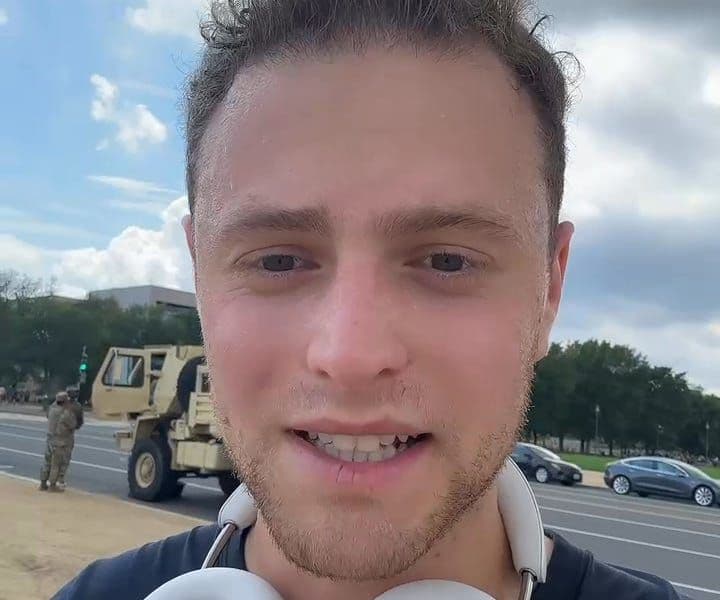
I’m writing right now from Washington, D.C., where—for the first time since I’ve been covering events here—I saw National Guard troops stationed on the National Mall. The scene stopped me in my tracks. About five or six members moved together in a small convoy, their uniforms crisp, their posture straight, their presence unmistakable against the vast openness of the Mall.
The setting was almost cinematic: the Capitol dome gleaming in the afternoon sun on one side, the Washington Monument stretching skyward on the other. There was no visible emergency, no crowd in distress, no crime unfolding—just this quiet, yet undeniably forceful, show of military presence in the heart of the nation’s capital.
I promised I’d report to you from the ground, and that’s exactly what I’m doing — no corporate newsroom, no billionaire backers, just me, my phone, and your support making this possible. Please subscribe today and support my work. I can only do this with your subscriptions.
Subscribe
As I stood nearby, I noticed the range of reactions from passersby. A man in a baseball cap slowed his stride, nodded toward the troops, and said simply, “Thank you for your service,” before moving on. A woman pushing a stroller called out, “Go home!” in a voice that was sharp but not loud enough to startle her child. Others lingered on the sidewalk, uncertain whether to engage or keep walking.
Tourists with cameras and smartphones hovered at a respectful distance, taking photos as if the troops were part of the city’s attractions. The mood was not hostile, but neither was it entirely calm—it was something stranger, a mix of everyday life and the kind of quiet tension that comes when authority arrives without a visible cause.
The location made the scene even more striking. The troops were positioned in a section of the Mall where crime is rare, sandwiched between two of the most iconic landmarks in America.
A few joggers passed by, weaving between groups of visitors. Children chased one another across the grass. Vendors sold bottled water and pretzels under the shade of small white tents. It was, in many ways, a normal afternoon—except for the soldiers standing watch with rifles slung across their chests.
Back in my own neighborhood, however, the day had started on a more openly tense note. This morning, residents reported seeing ICE officers patrolling the streets. At least one arrest was made.
Rumors have been circulating that this was only the beginning, that tonight there would be more National Guard troops in the city and additional checkpoints set up. For those who have lived here a long time, the talk carried a particular weight. D.C. has seen many moments of heightened security, but it’s different when the buildup is gradual, when the presence grows from morning to night.
Throughout the day, messages have poured in from friends and readers, many of them asking the same thing: Am I safe? I want to reassure you—I am. I make a point of clearly identifying myself as press whenever approached, and so far, I have felt safe while reporting.
That doesn’t mean there’s no risk. Being visible in moments like these can draw attention, and not always the good kind. Law enforcement, whether local police or federal officers, do not always welcome questions, cameras, or notes being taken. But my work depends on being here, seeing for myself, and sharing what I witness.
This is the work I love. The truth is more important than my comfort, and no amount of uniforms, checkpoints, or veiled threats will stop me from telling these stories. Tonight, I’ll be back out on the streets, notebook in hand, eyes open, documenting whatever unfolds. In a city where the presence of power is a constant backdrop, the real story is always in the details—what happens between the monuments, between the lines of official statements, in the spaces where ordinary life meets extraordinary force. And right now, those spaces are where I’ll be.
Subscribe